1. Plural of nouns
Nouns: all things that exist or not.
Ex: spirit - espírito
alarm - alarm
gun - chiclete
Plural: spirit - spirits
alarm - alarms
gun - guns
We have specific nouns that have a different form of plural. Let's see!
* When the nouns have oo, they become ee.
Ex: foot (pé) --- feet (pés)
* When the nouns have -f or -fe, they become -ves
Ex: knife (faca) --- knives (facas)
* Some nouns will be different in their plural.
Ex: mouse (rato) --- mice (ratos)
child (criança) --- children (crianças)
woman (mulher) --- women (mulheres)
man (homem) --- men (homens)
ox (boi) --- oxen (bois)
* Some nouns will be the same, in plural or in singular.
Ex: fish (peixe/peixes)
sheep (ovelha/ovelhas)
fruit (fruta/frutas)
2. Adjectives
Adjective is qualities of a noun.
Ex: awesome (maravilhoso)
* The adjectives is coming with verb to be.
Ex: I was thin. (Eu era magro)
I am thin. (Eu sou magro)
* The adjectives won't never be plural.
Wrong: They are thins. ---- no correct
Correct: They are thin. ---- correct
3. Definite articles
We can definite the nouns. We all use ''the'' for definite ones.
Ex: The car (o carro)
The spirits (os espíritos)
We can use them in plural or in singular.

Mostrando postagens com marcador english. Mostrar todas as postagens
Mostrando postagens com marcador english. Mostrar todas as postagens
domingo, 17 de janeiro de 2016

sexta-feira, 15 de janeiro de 2016
Aula 12 - Mathmatic; Indefinite articles
1. Mathmatic
We usually say basic math operations like this:
+ plus
- minus
x times
/ divided by
2 + 2 = 4 -- two plus two equals four
4 - 4 = 0 -- four minus four equals zero
6 x 2 = 12 -- six times two equals twelve
20 / 10 = 2 -- twenty divided by ten equals two
2. Indefinite articles
We use a or an to indicate a thing that we don't know.
a - used for consoants sound
Ex: a car - um carro
a favor - um favor
an - used for vowel sound
Ex: an elephant - um elefante
an yard - um jardim (yard starts with ''y'', but the sound is ''i'')
We usually say basic math operations like this:
+ plus
- minus
x times
/ divided by
2 + 2 = 4 -- two plus two equals four
4 - 4 = 0 -- four minus four equals zero
6 x 2 = 12 -- six times two equals twelve
20 / 10 = 2 -- twenty divided by ten equals two
2. Indefinite articles
We use a or an to indicate a thing that we don't know.
a - used for consoants sound
Ex: a car - um carro
a favor - um favor
an - used for vowel sound
Ex: an elephant - um elefante
an yard - um jardim (yard starts with ''y'', but the sound is ''i'')
terça-feira, 12 de janeiro de 2016
Aula 11 - Prepositions of place
Prepositions of place is used to say a thing and its place. We always use them day-by-day.
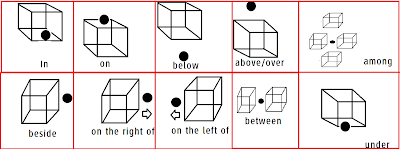
On - em cima (The ball is on the box)
In (into) - dentro (The ball is into the box)
Under - embaixo (The ball is under the box)
Above - acima (The ball is above the box)
Below - abaixo (The ball is below the box)
Beside - ao lado (The ball is beside the box)
Behind - atrás (The ball is behind the box)
In front of - a frente (The ball is in front of the box)
On the right of - à direita de (The ball is on the right of the box)
On the left of - à esquerda de (The ball is on the left of the box)
Between - entre duas coisas (The ball is between the boxes)
Among - entre várias coisas (The ball is among the boxes)

On - em cima (The ball is on the box)
In (into) - dentro (The ball is into the box)
Under - embaixo (The ball is under the box)
Above - acima (The ball is above the box)
Below - abaixo (The ball is below the box)
Beside - ao lado (The ball is beside the box)
Behind - atrás (The ball is behind the box)
In front of - a frente (The ball is in front of the box)
On the right of - à direita de (The ball is on the right of the box)
On the left of - à esquerda de (The ball is on the left of the box)
Between - entre duas coisas (The ball is between the boxes)
Among - entre várias coisas (The ball is among the boxes)
quarta-feira, 6 de janeiro de 2016
Aula 10 - Present continous; simple past
1. Present Continous
We have learned about ''Simple Present'', that says an action that happens on present time. But, we have to understand how to explain an action or state that is happening in the same moment.
For this, we always have it:
verb to be (pres.) + verb - ing
Ex: I am working now.
We are going.
Question form: Are you working now? (Remember that ''verb to be'' in questions comes first than pronoum)
Affirmative form: Yes, I am working now.
Negative form: No, I am not working now.
2. Simple Past
Used for say a thing that happened and overed in the past.
For asking:
Did you come here? (Did is past of ''do''. It is a aux.verb, indicating an action in past)
Yes, I came here. (CAME is a verb in past)
No, I did not come here. (''Did'' comes to the sentense with ''not'', and ''come'' is on present, because of ''did'', that is past)
* Form of verb
We always have a verb in past form on ''Simple Past''. But, the verbs is divided in IRREGULAR and REGULAR verb. Some of there are irregular, and others are regular.
Regular verb: the verbs that are regular always comes -d (or -ed) after the verb. For example:
I lived in Miami.
I stopped driving here.
________ observation ________
We have learned about ''Simple Present'', that says an action that happens on present time. But, we have to understand how to explain an action or state that is happening in the same moment.
For this, we always have it:
verb to be (pres.) + verb - ing
Ex: I am working now.
We are going.
Question form: Are you working now? (Remember that ''verb to be'' in questions comes first than pronoum)
Affirmative form: Yes, I am working now.
Negative form: No, I am not working now.
2. Simple Past
Used for say a thing that happened and overed in the past.
For asking:
Did you come here? (Did is past of ''do''. It is a aux.verb, indicating an action in past)
Yes, I came here. (CAME is a verb in past)
No, I did not come here. (''Did'' comes to the sentense with ''not'', and ''come'' is on present, because of ''did'', that is past)
* Form of verb
We always have a verb in past form on ''Simple Past''. But, the verbs is divided in IRREGULAR and REGULAR verb. Some of there are irregular, and others are regular.
Regular verb: the verbs that are regular always comes -d (or -ed) after the verb. For example:
I lived in Miami.
I stopped driving here.
________ observation ________
- Verbos já terminados em E apenas ganham o D: dance = danced
- Verbos terminados em consoante+y, perdem o Y e ganham IED: study = studied.
- Verbos terminados em vogal+y, apenas ganham ED: play = played.
- Verbos terminados em consoante+vogal+consoante e cuja última sílaba seja a tônica, dobram a última consoante e ganham ED: stop = stopped
___________________________
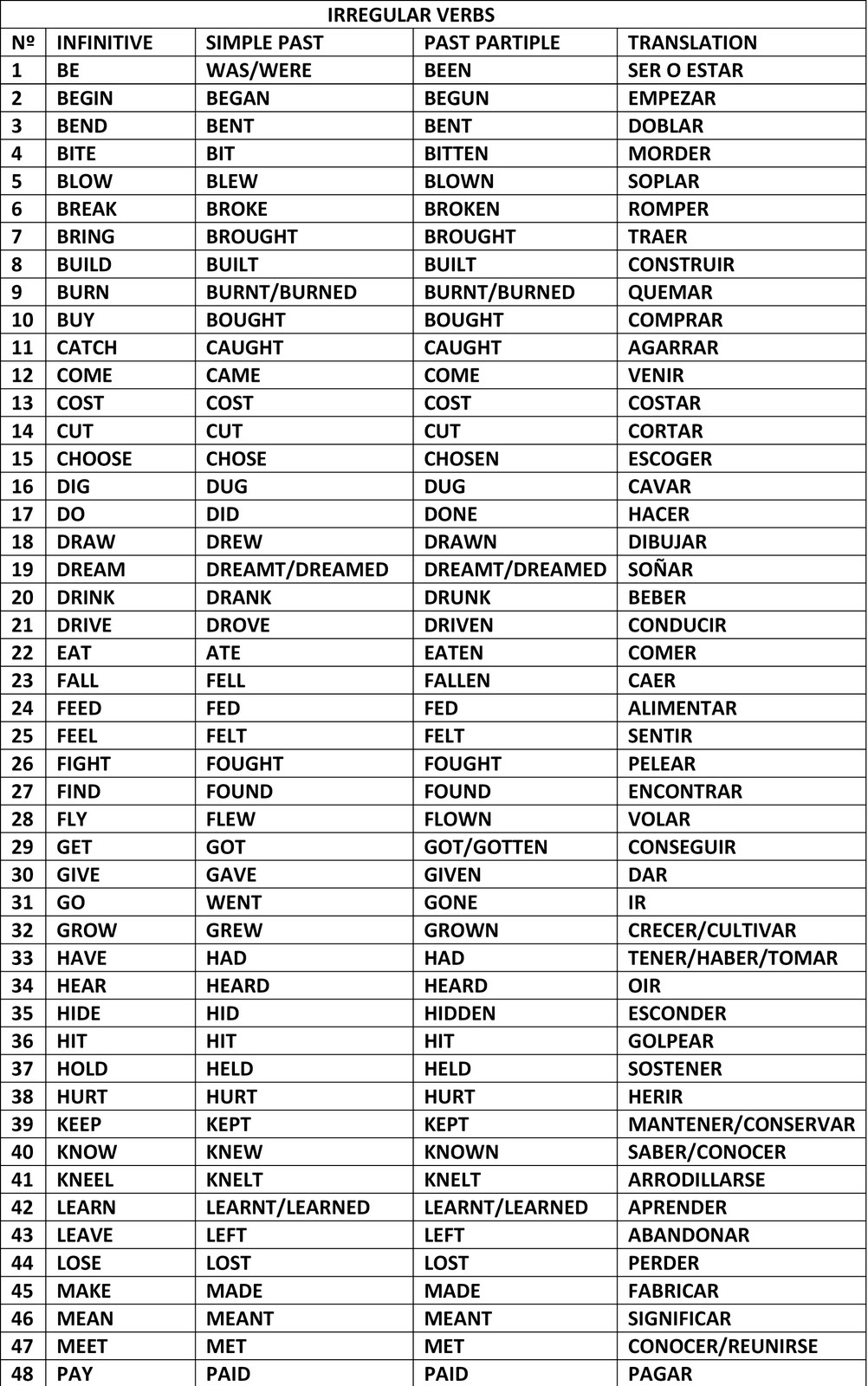
Irregular verb: they have all forms. Don't have a specific rule to know. Below, we have a list of verbs. (Obs: the third column is other thing. At this moment, forget it. Look for the first and second column). Image capted on https://irregularverbsforus.files.wordpress.com/2011/09/verboos_11.jpg)
terça-feira, 5 de janeiro de 2016
Aula 8 - Prepositions: at/on/in
A reader asked it on Whatsapp about how to use prepositions at, on and in. Let's see:

TIME USING
At - more specific
Use: hours and period of time
Ex: at night, at noon, at 3h30 pm
On - more or less specific
Use: days of the week and months
Ex: on january, on december, on wednesday
In - less specific
Use: years, seasons of the year and century
Ex: in 1932, in 21st century, in autumm
PLACE USING
At - more specific
Use: completed adress, specific places
Ex: at home, at Extra Supermarket, at 233 Paulista Avenue
On - more or less specific
Use: name of streets and avenue
Ex: on Paulista Avenue, on Sé Square
In - less specific
Use: continents, countries, states, provinces, cities etc related to it,
Ex: in Africa, in Brazil, in Tatuapé etc.
TIME USING
At - more specific
Use: hours and period of time
Ex: at night, at noon, at 3h30 pm
On - more or less specific
Use: days of the week and months
Ex: on january, on december, on wednesday
In - less specific
Use: years, seasons of the year and century
Ex: in 1932, in 21st century, in autumm
PLACE USING
At - more specific
Use: completed adress, specific places
Ex: at home, at Extra Supermarket, at 233 Paulista Avenue
On - more or less specific
Use: name of streets and avenue
Ex: on Paulista Avenue, on Sé Square
In - less specific
Use: continents, countries, states, provinces, cities etc related to it,
Ex: in Africa, in Brazil, in Tatuapé etc.
segunda-feira, 4 de janeiro de 2016
Aula 7 - Dates, Months, Years and Days of the Week
In Portuguese. we say dates at this form:
Day/Month/Year.
But in English, we Always have the form to say dates:
month / date / year
Now, let's learn more about it:
Day/Month/Year.
But in English, we Always have the form to say dates:
month / date / year
Now, let's learn more about it:
- Months
- January
- February
- March
- April
- May
- June
- July
- August
- September
- October
- November
- December
- Dates
- We always say date in ordinal number, never in cardinal, like us, Brazilians. So, we have to remember the ordinal numbers, 1st to 31st.
- Ex: 25th - twenty fifth
- Year
- We divide the numbers in two parts, usually on the middle.
- Ex: 2015: 20|15 - twenty|fifteen: twenty fifteen
- 1992: 19|92 - nineteen|ninety two: nineteen ninety two
- Days of the week
- Sunday
- Monday
- Tuesday
- Wednesday
- Thursday
- Friday
- Saturday
- Obs: Saturday and Sunday are on Weekends.
So, if we want to pronunciate, in English this date: 19 de Fevereiro de 2016, we will say
> February 19th, 2016 (February nineteenth, twenty sixteen)
> 02/19/2016, if you want to write at this form (always mm/dd/yyyy)
(This date is on friday)
Aula 6 - Ordinal Numbers (21st-100th); Hours
1. Ordinal Numbers (21st-100th)
We have learned about numbers and their positions. Now, we'll learn more!
20th- twentieth
21th- twenty first (after this number, we will say the cardinal form and after the position)
(card.) (ord.)
22nd- twenty second (twenty is cardinal; second is the ordinal)
23rd- twenty third
24th- twenty fourth
....
30th- thirtieth
40th- fortieth
50th- fiftieth
60th- sixtieth
70th- seventieth
80th- eightieth
90th- ninetieth
100th- a hundredth
Only these numbers (30th-100th) will be different, putting -ieth. And other numbers between them will be respected the rule above: cardinal + ordinal form
Ex: 34th- 30 (thirty)+ 4th (fourth) - thirty fourth
56 th- 50 (fifty)+ 6th (sixth) - fifty sixth
Always this....
2. Hours
We always ask this question to ask for hour:
a_ What time is it?
b_ It's...
In this case, we have forms to say the hour. But, we have to know that USA and some countries divide the hour in two:
''a.m'' (anti meridian) if the hour is between 00h00 to 11h59 (morning)
''p.m'' (post meridian) if the hour is between 12h00 to 11h59 (night)
4h00 - It's four o'clock (o'clock is used to exactly hour)
It's four pm.
It's four am.
5h20 - It's five twenty.
It's five twenty pm.
It's five twenty am.
Always saying the numbers.
We have learned about numbers and their positions. Now, we'll learn more!
20th- twentieth
21th- twenty first (after this number, we will say the cardinal form and after the position)
(card.) (ord.)
22nd- twenty second (twenty is cardinal; second is the ordinal)
23rd- twenty third
24th- twenty fourth
....
30th- thirtieth
40th- fortieth
50th- fiftieth
60th- sixtieth
70th- seventieth
80th- eightieth
90th- ninetieth
100th- a hundredth
Only these numbers (30th-100th) will be different, putting -ieth. And other numbers between them will be respected the rule above: cardinal + ordinal form
Ex: 34th- 30 (thirty)+ 4th (fourth) - thirty fourth
56 th- 50 (fifty)+ 6th (sixth) - fifty sixth
Always this....
2. Hours
We always ask this question to ask for hour:
a_ What time is it?
b_ It's...
In this case, we have forms to say the hour. But, we have to know that USA and some countries divide the hour in two:
''a.m'' (anti meridian) if the hour is between 00h00 to 11h59 (morning)
''p.m'' (post meridian) if the hour is between 12h00 to 11h59 (night)
4h00 - It's four o'clock (o'clock is used to exactly hour)
It's four pm.
It's four am.
5h20 - It's five twenty.
It's five twenty pm.
It's five twenty am.
Always saying the numbers.
terça-feira, 29 de dezembro de 2015
Aula 5 - Cardinal Numbers (101-1000); Ordinal Numbers (1st-20th)
1. Cardinal Numbers (101-1000)
100 - One Hundred
200 - Two Hundred
300 - Three Hundred
400 - Four Hundred
500 - Five Hundred
600 - Six Hundred
700 - Seven Hundred
800 - Eight Hundred
900 - Nine Hundred
1000 - One Thousand
If we have to say a number, for example 403, we:
*say FOUR HUNDRED THREE, because 400 (four hundred) + 3 (three)
201 - two hundred one (because 200 [two hundred] + 1 [one])
319 - three hundred nineteen (because 300 [three hundred] + 19 [nineteen])
928 - nine hundred twenty eight (because 900 [nine hundred] + 28 [twenty eight])
etc.....
2. Ordinal Numbers (1st - 20th)
This is used to give order, or position of something.
First - 1st (the 2 lasts letters come to the number, always in all number)
Second - 2nd
Third - 3rd
Fourth - 4th
Fifth - 5th
Sixth - 6th
Seventh - 7th
Eighth - 8th
Ninth - 9th
Tenth - 10th
Eleventh - 11th
Twelfth - 12th
Thirtheenth - 13th
Fourteenth - 14th
Fifteenth - 15th
Sixteenth - 16th
Seventeenth - 17th
Eighteenth - 18th
Nineteenth - 19th
Twentieth - 20th
Observe that the basis of the name (ex: fourteenth) is the same as the cardinal numbers (fourteen), adding sometimes ''th''. But, be careful: some numbers have to be modified.
Ex: Twentieth - the original is TWENTY.
twenty - twentieth
Ex: Twelfth - the original is TWELVE
twelve - twelfth
The sound of ''th'' is almost the same as /ff/. Ex: ninth: //nainff//
100 - One Hundred
200 - Two Hundred
300 - Three Hundred
400 - Four Hundred
500 - Five Hundred
600 - Six Hundred
700 - Seven Hundred
800 - Eight Hundred
900 - Nine Hundred
1000 - One Thousand
If we have to say a number, for example 403, we:
*say FOUR HUNDRED THREE, because 400 (four hundred) + 3 (three)
201 - two hundred one (because 200 [two hundred] + 1 [one])
319 - three hundred nineteen (because 300 [three hundred] + 19 [nineteen])
928 - nine hundred twenty eight (because 900 [nine hundred] + 28 [twenty eight])
etc.....
2. Ordinal Numbers (1st - 20th)
This is used to give order, or position of something.
First - 1st (the 2 lasts letters come to the number, always in all number)
Second - 2nd
Third - 3rd
Fourth - 4th
Fifth - 5th
Sixth - 6th
Seventh - 7th
Eighth - 8th
Ninth - 9th
Tenth - 10th
Eleventh - 11th
Twelfth - 12th
Thirtheenth - 13th
Fourteenth - 14th
Fifteenth - 15th
Sixteenth - 16th
Seventeenth - 17th
Eighteenth - 18th
Nineteenth - 19th
Twentieth - 20th
Observe that the basis of the name (ex: fourteenth) is the same as the cardinal numbers (fourteen), adding sometimes ''th''. But, be careful: some numbers have to be modified.
Ex: Twentieth - the original is TWENTY.
twent
Ex: Twelfth - the original is TWELVE
twel
The sound of ''th'' is almost the same as /ff/. Ex: ninth: //nainff//
segunda-feira, 28 de dezembro de 2015
Aula 4 - Cardinal Numbers (01-100); Alphabet
1. Cardinal Numbers - 01 to 100
1 One
2 Two
3 Three
4 Four
5 Five
6 Six
7 Seven
8 Eight
9 Nine
10 Ten
11 Eleven
12 Twelve
13 Thirteen
14 Fourteen
15 Fifteen
16 Sixteen
17 Seventeen
18 Eighteen
19 Nineteen
20 Twenty
30 Thirty
40 Forty
50 Fifty
60 Sixty
70 Seventy
80 Eighty
90 Ninety
100 A Hundred or One Hundred
Between 21 - 99, all numbers is combinated, like this:
Ex: 24 - twenty four
Ex: 44 - forty four
Ex: 51 - fifty one
Ex: 77 - seventy seven
Ex: 99 - ninety nine
Ex: 29 - twenty nine
Ex: 41 - forty one
2. The Alphabet
The alphabet is pronunciated like this sounds, nearly.
A /ei/
B /bi/
C /ci/
D /di/
E /i/
F /eff/
G /di/
H /aid/
I /ai/
J /jei/
K /kel/
L /el/
M /emm/
N /enn/
O /oul/
P /pi/
Q /qiu/
R /ar/
S /ess/
T /ti/
U /iu/
V /vi/
W /doubliu/
X /ecs/
Y /uaid/
Z /zi/
1 One
2 Two
3 Three
4 Four
5 Five
6 Six
7 Seven
8 Eight
9 Nine
10 Ten
11 Eleven
12 Twelve
13 Thirteen
14 Fourteen
15 Fifteen
16 Sixteen
17 Seventeen
18 Eighteen
19 Nineteen
20 Twenty
30 Thirty
40 Forty
50 Fifty
60 Sixty
70 Seventy
80 Eighty
90 Ninety
100 A Hundred or One Hundred
Between 21 - 99, all numbers is combinated, like this:
Ex: 24 - twenty four
Ex: 44 - forty four
Ex: 51 - fifty one
Ex: 77 - seventy seven
Ex: 99 - ninety nine
Ex: 29 - twenty nine
Ex: 41 - forty one
2. The Alphabet
The alphabet is pronunciated like this sounds, nearly.
A /ei/
B /bi/
C /ci/
D /di/
E /i/
F /eff/
G /di/
H /aid/
I /ai/
J /jei/
K /kel/
L /el/
M /emm/
N /enn/
O /oul/
P /pi/
Q /qiu/
R /ar/
S /ess/
T /ti/
U /iu/
V /vi/
W /doubliu/
X /ecs/
Y /uaid/
Z /zi/
quarta-feira, 23 de dezembro de 2015
Aula 3 - Questions, Affirmative and Negative answers; does
1. Questions and Answers
We can make questions in English, and have two options of answer: negative or positive. We have two types of verb: action or state.
Do is a verb, witch meaning is ''fazer''. But it also has another meaning. It is auxiliary verb, indicates the verbal time, form of verb (action) and if the sentense has to be answered with present. It always comes before the sentense. After, the pronoum appears and the action verb too.
Question: Do you study? (Observe that ''do'' is a auxiliary verb, and always come first/ after we have ''you'')
Answer: Yes, I study.
No, I do not study. (In this case, ''do'' comes after the pronoum, and appears the ''not'' too.)
If the verb is state (you are), so we have to use verb to be, following the same structure.
Question: Are they happy? (Change the position, transforming in this: verb to be+ pronoum)
Answer: Yes, they are happy. (Use the common position: pronoum+ verb to be)
No, they are not happy. (Use ''not'' after the verb to be)
2. Does
''Does'' is the same meaning as ''do''. But, it is used ONLY in He, She and It.
Question: Does she drive a car? (''Does'' always come first and after the pronoum)
Answer: Yes, she drives a car. (After the verb, we always put ''s'' or ''es'' (depend on the verb))
No, she does not drive a car. (In this case, we do not put ''s'' or ''es'' after the verb, because
of the auxiliary ''does not'', that ever indicates third of singular)
Verbs rules
We can make questions in English, and have two options of answer: negative or positive. We have two types of verb: action or state.
Do is a verb, witch meaning is ''fazer''. But it also has another meaning. It is auxiliary verb, indicates the verbal time, form of verb (action) and if the sentense has to be answered with present. It always comes before the sentense. After, the pronoum appears and the action verb too.
Question: Do you study? (Observe that ''do'' is a auxiliary verb, and always come first/ after we have ''you'')
Answer: Yes, I study.
No, I do not study. (In this case, ''do'' comes after the pronoum, and appears the ''not'' too.)
If the verb is state (you are), so we have to use verb to be, following the same structure.
Question: Are they happy? (Change the position, transforming in this: verb to be+ pronoum)
Answer: Yes, they are happy. (Use the common position: pronoum+ verb to be)
No, they are not happy. (Use ''not'' after the verb to be)
2. Does
''Does'' is the same meaning as ''do''. But, it is used ONLY in He, She and It.
Question: Does she drive a car? (''Does'' always come first and after the pronoum)
Answer: Yes, she drives a car. (After the verb, we always put ''s'' or ''es'' (depend on the verb))
No, she does not drive a car. (In this case, we do not put ''s'' or ''es'' after the verb, because
of the auxiliary ''does not'', that ever indicates third of singular)
Verbs rules
- Sempre acrescente -s ao verbo: reads, writes, opens, sleeps, sings, sits, walks, runs, sees, etc.;
- Se o verbo terminar com a letra -o, -s, -ch, -sh, -x, ou -z acrescente -es: goes, does, misses, watches, washes, fixes, buzzes, etc.
- Se o verbo terminar em uma sequência de consoante e -y, tire o -y e acrescente -ies: cry » cries, try » tries, study » studies, reply » replies, etc. (Obs.: se o verbo terminar em uma sequência de vogal e -y, basta acrescentar -s: pray » prays, say » says, play » plays);
- O verbo have é uma exceção a tudo isso, pois ele terá a forma has.
terça-feira, 22 de dezembro de 2015
AULA 2 - OBJECT PRONOUMS; INFINITIVE VERBS
1. Object pronoums
We have the personal pronoums (I, You, He, She, It, You, We, They). They are used only on the beggining of the sentense.
Example: You are beautiful. (Você é bonita)
(Observe that ''YOU'' is on the beggining of the sentense / first word)
But, some cases, we have to use pronoums on the middle or on the final part of the sentense. In this case, we can not use personal pronoums!!! But what can we use? In this case, we have Object Pronoums. Let's see.
I - me
You - you
He - his
She - her
It - it
You - you
We - us
They - them
We use object pronoums to indicate something or someone.
Example: I like to visit Maria. (Eu gosto de visitar Maria.)
I like to visitshe. (The pronoums ''she'' won't be stayed at the over of the sentense, nor other personal pronoums, only object pronoums.)
I like to visit her. (Eu gosto de visitá-la.)
2. Infinitive verbs
Infinitive verbs are ''neutral verbs'', which verbs can be conjugated. They are together with ''to''.
To be - ser / estar
To drink - beber
To like - gostar
To eat - comer
To repeat - repetir
To use - usar
To sleep - dormir
To walk - andar
To want - querer
To wish - desejar
etc.............. Of course, we have a lot of verbs. We put only 10 just to give sample example. While the class are passing, we will learn new verbs and these structure on the sentense.
Example: I drink. (Eu bebo.)
They sleep. (Eles dormem.)
We have the personal pronoums (I, You, He, She, It, You, We, They). They are used only on the beggining of the sentense.
Example: You are beautiful. (Você é bonita)
(Observe that ''YOU'' is on the beggining of the sentense / first word)
But, some cases, we have to use pronoums on the middle or on the final part of the sentense. In this case, we can not use personal pronoums!!! But what can we use? In this case, we have Object Pronoums. Let's see.
I - me
You - you
He - his
She - her
It - it
You - you
We - us
They - them
We use object pronoums to indicate something or someone.
Example: I like to visit Maria. (Eu gosto de visitar Maria.)
I like to visit
I like to visit her. (Eu gosto de visitá-la.)
2. Infinitive verbs
Infinitive verbs are ''neutral verbs'', which verbs can be conjugated. They are together with ''to''.
To be - ser / estar
To drink - beber
To like - gostar
To eat - comer
To repeat - repetir
To use - usar
To sleep - dormir
To walk - andar
To want - querer
To wish - desejar
etc.............. Of course, we have a lot of verbs. We put only 10 just to give sample example. While the class are passing, we will learn new verbs and these structure on the sentense.
Example: I drink. (Eu bebo.)
They sleep. (Eles dormem.)
AULA 1 - PRONOUMS, VERB TO BE AND CONTRACTION
1. Pronoums
Pronoums is used to substitute a name and indicate someone or something. Let's see about the pronoums:
I - eu
You - você
He - ele
She - ela
It - ele / ela (para animais, objetos, lugares)
You - vocês
We - nós
They - eles / elas (incluindo também animais, objetos, lugares)
2. Verb to be
Verb is an action or reaction of something. The first verb we learn is ''to be''. Verb to be is, in Portuguese, ''ser'' ou ''estar''. Let's see the verb on the pronoums.
I am - eu sou / eu estou
You are - você é / você está
He is - ele é / ele está
She is - ela é / ela está
It is - ele(a) é / ele(a) está (para animais, objetos, lugares)
You are - vocês são / vocês estão
We are - nós somos / nós estamos
They are - eles(as) são / eles(as) estão
Example: I am ugly (Eu sou feio)
We are happy (Nós estamos felizes)
3. Contraction
The verb to be can be contracted, or be ''small''. Is the same as ''está'' para ''tá''. In this example, the word ''tá'' is contraction of ''está''. The meaning is the same, not changing anything.
I am - I'm
You are - You're
He is - He's
She is - She's
It is - It's
You are - You're
We are - We're
They are - They're
Example: We are happy. (Nós estamos felizes)
We're happy. (Nós estamos felizes)
Observation: ''You'' can be singular (''você'') e também plural (''vocês''), using the same structure. How can we know if it is singular or plural? Only the context of the sentense.
Pronoums is used to substitute a name and indicate someone or something. Let's see about the pronoums:
I - eu
You - você
He - ele
She - ela
It - ele / ela (para animais, objetos, lugares)
You - vocês
We - nós
They - eles / elas (incluindo também animais, objetos, lugares)
2. Verb to be
Verb is an action or reaction of something. The first verb we learn is ''to be''. Verb to be is, in Portuguese, ''ser'' ou ''estar''. Let's see the verb on the pronoums.
I am - eu sou / eu estou
You are - você é / você está
He is - ele é / ele está
She is - ela é / ela está
It is - ele(a) é / ele(a) está (para animais, objetos, lugares)
You are - vocês são / vocês estão
We are - nós somos / nós estamos
They are - eles(as) são / eles(as) estão
Example: I am ugly (Eu sou feio)
We are happy (Nós estamos felizes)
3. Contraction
The verb to be can be contracted, or be ''small''. Is the same as ''está'' para ''tá''. In this example, the word ''tá'' is contraction of ''está''. The meaning is the same, not changing anything.
I am - I'm
You are - You're
He is - He's
She is - She's
It is - It's
You are - You're
We are - We're
They are - They're
Example: We are happy. (Nós estamos felizes)
We're happy. (Nós estamos felizes)
Observation: ''You'' can be singular (''você'') e também plural (''vocês''), using the same structure. How can we know if it is singular or plural? Only the context of the sentense.
Assinar:
Postagens (Atom)